Your dishes are clean. But what is left on the plates?
What regular dishwasher tabs and rinse aid leave behind on the dishes your family eats from every day. And an alternative that cleans powerfully, yet is free from microplastics.

Perhaps you know the feeling. You take a freshly rinsed glass out of the dishwasher, and with the first sip of water, it tastes slightly of dish soap.
Many think it's their imagination. It's not.
The question is what actually remains on the dishes after the machine has run its cycle. And whether the eco-alternatives that so many are switching to actually clean what they're supposed to.
There's a study on it. There are people who repair dishwashers and see every day what accumulates inside them. Both are worth looking at. What stands out is presented here so you can decide for yourself.
Let's start with the glass that tastes like dish soap.
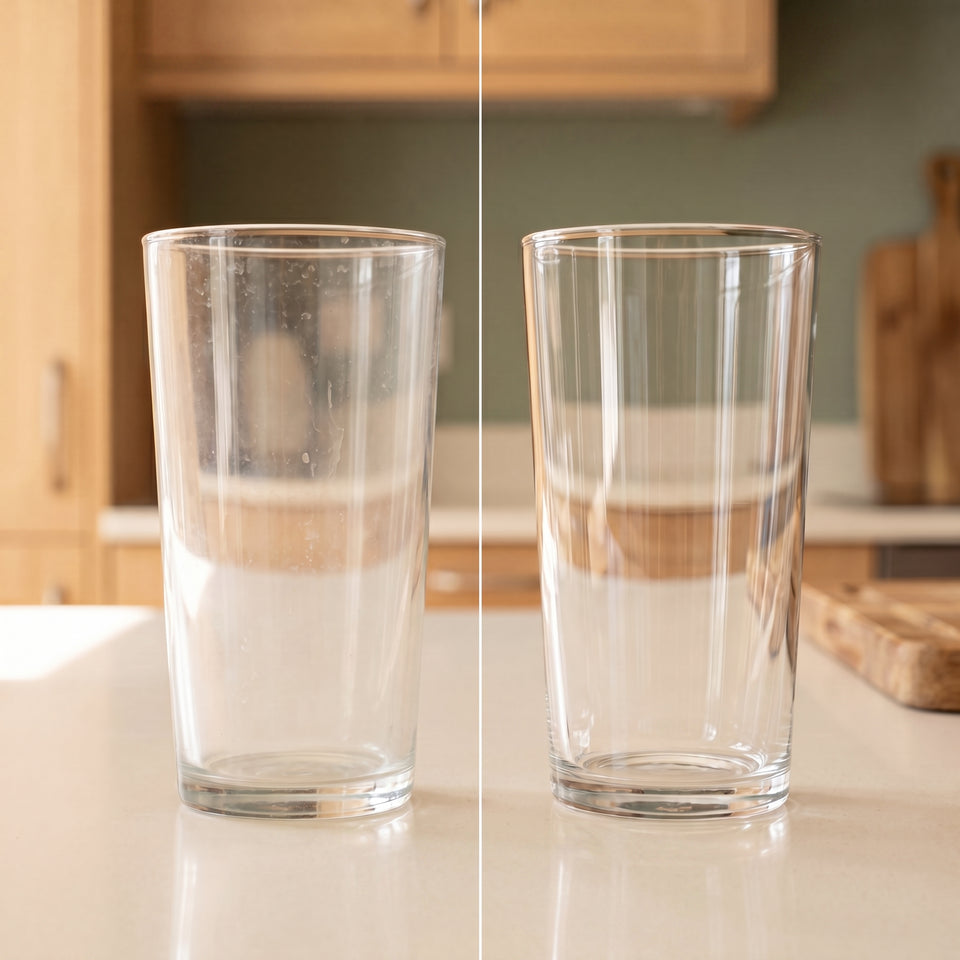
One.The dish soap taste in the glass is not your imagination
You're not imagining it. If your freshly rinsed glass tastes slightly of dish soap, then there's residue.
A dishwasher rinses with water. But not every molecule is washed away. A thin film remains on the dishes, even if you don't see it.
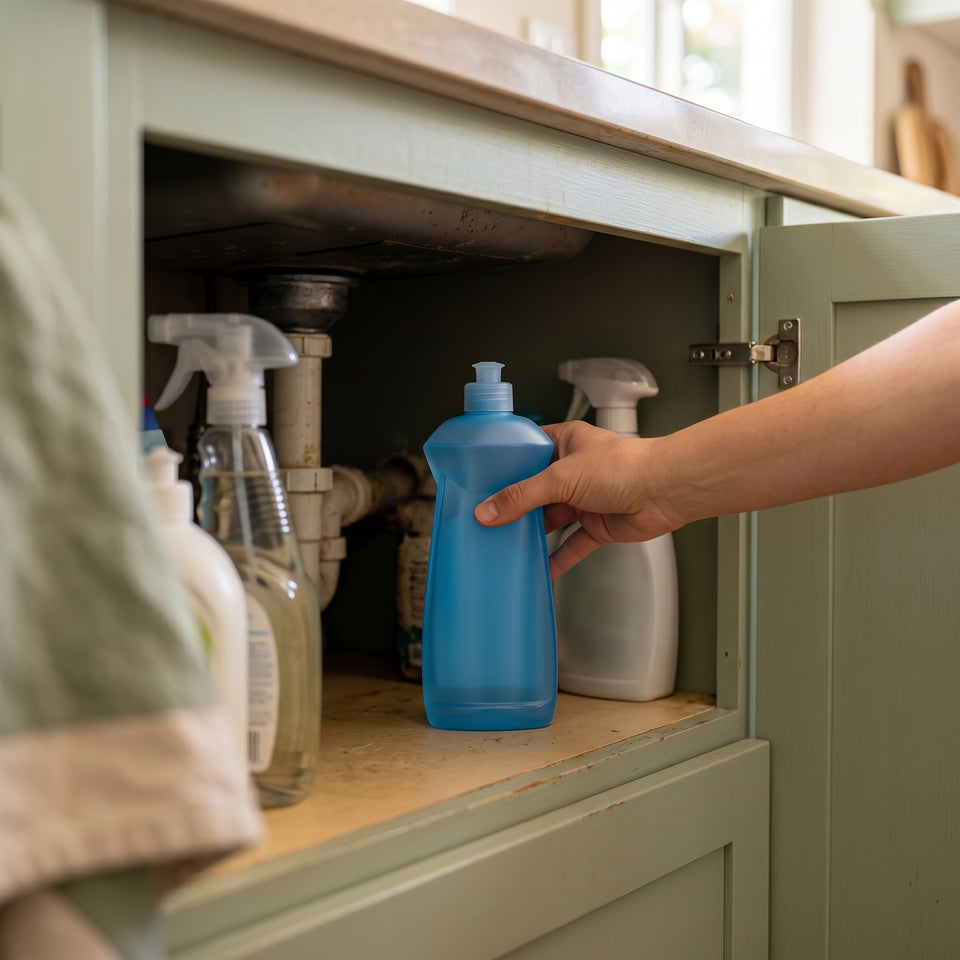
With tabs and rinse aid, this is exactly what is intended. The rinse aid is supposed to ensure that the water drains faster and no drops dry. For this to work, some residue remains. It's back with the next meal.
And the meal after that too. This happens every day, on every plate that you and your children eat from.
This is exactly where a closer look is worthwhile.
Doesn't the machine just wash away the residue?
Partially, yes. But rinse aid is specifically designed to leave a thin film so that water beads off and no drops dry. This film remains, even after rinsing. That's exactly what you taste in the glass.
Warum spült die Maschine die Rückstände nicht einfach ab?
Aus zwei Gründen. Die Tenside aus dem Tab werden beim Nachspülen nie vollständig abgespült, ein dünner Rest bleibt immer. Und der Klarspüler kommt erst im allerletzten Spülgang in die Maschine, danach wird gar nichts mehr nachgespült. Genau das ist sein Zweck: Er soll auf dem Geschirr bleiben, damit es schneller trocknet und glänzt.
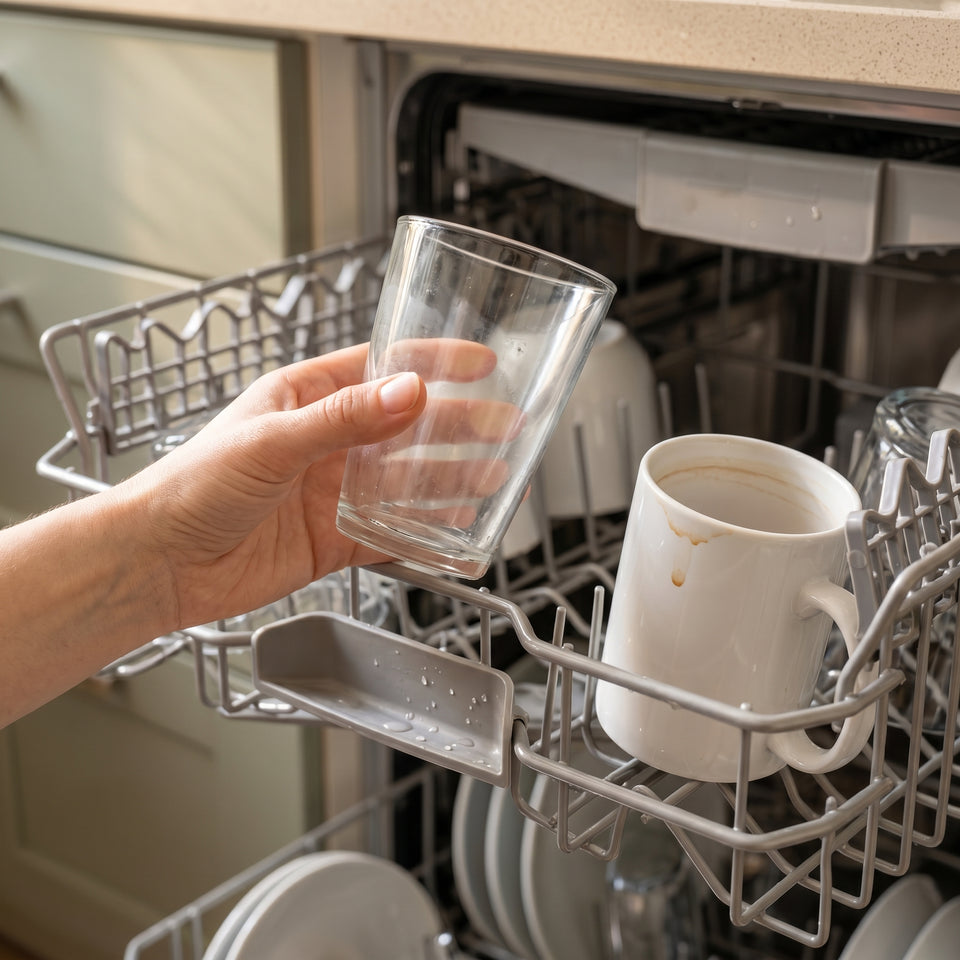
2.Why many eco-friendly wipes don't clean properly
Many who switched to an eco-product were disappointed afterwards. The dishes came out greasy. Residues still stuck to the rim, dried-on food remained dried-on.
The problem is usually the cleaning power. Many plastic-free sheets are simply too weak. Grease and dried-on residues need more than most of them provide.
And there's something else many people don't know. Water-soluble does not mean biodegradable. There's a difference.
Many products that advertise as "plastic-free" still have a thin film around the actual agent. This film dissolves in water. But dissolved doesn't mean gone. It just becomes invisible and ends up as a substance in the wastewater.
So you buy a clear conscience, and in the end, you don't really have either. Not clean enough, and not as clean for your conscience as it says on the label.
Do the sheets really clean as effectively as regular tabs?
The cleaning power comes from the enzyme protease. It breaks down dried-on protein and food residues. You don't need a rinse aid for this.
Was ist Protease überhaupt?
Ein Enzym, also ein Stoff, der eine bestimmte Reaktion in Gang setzt. In diesem Fall: Eiweiß in kleine Bausteine zerlegen. Dein Körper nutzt Proteasen übrigens selbst, jeden Tag bei der Verdauung.
3.What researchers found on the dishes
Now for the study. Researchers at the University of Zurich investigated in 2022 what residues remain on dishes after a wash cycle.
One substance particularly concerned them: alkylethoxylates.
These are active washing agents. They are added to rinse aids and many tabs to help water drain better from dishes.
And now for the striking observation. Even in the amount actually remaining on the dishes, laboratory tests showed damage to the barrier of human intestinal cells.
This is a laboratory experiment, not proof of anything more. It simply states what was measured, and you can draw your own conclusions.
The obvious question: Can it be done without these substances and still get truly clean?
According to the manufacturer's data sheet, Tovara dishwasher sheets do not contain alkylethoxylates. They still get dishes clean because they work with an enzyme. It's called protease and breaks down dried protein and food residues. You don't need a rinse aid for that.
4.The Honest Comparison of the Three Paths
Essentially, there are three ways.
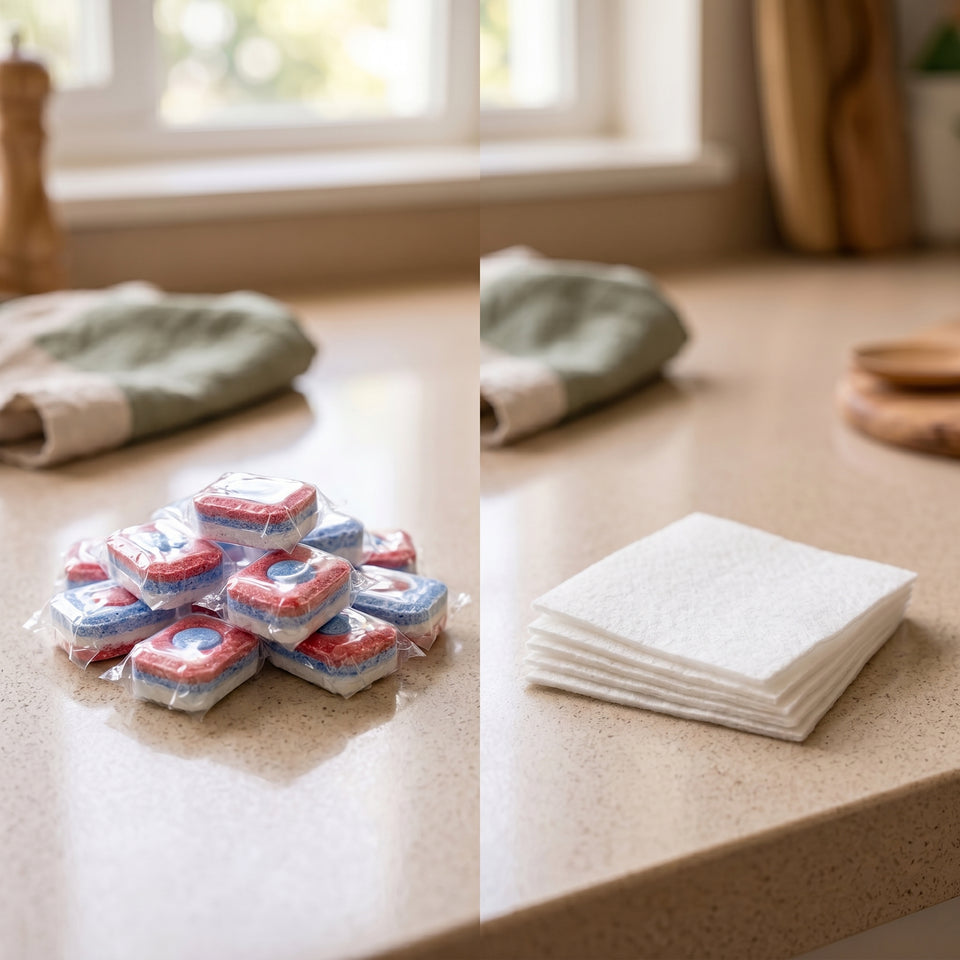
Normal tabs. They clean powerfully, there's no sugarcoating it. But they leave residues, often contain microplastics, and rinse aid is usually added.
Eco sheets. They give you a good conscience. But many are too weak, and quite a few still have a film around the actual agent.
Tovara Dishwasher Sheets. The idea behind them is that you don't have to choose between clean and clean for your conscience. Powerful due to the enzyme, without microplastics, without alkyl ethoxylates, and without the need for rinse aid. The packaging is plastic-free, made from FSC-certified cardboard. And the sheet itself not only dissolves, it is also biodegradable.
Werden die Gläser ohne Klarspüler nicht streifig?
Nein. Die Spülmaschinen-Blätter sind so gemacht, dass Gläser auch ohne Klarspüler streifenfrei trocknen. Die Flasche unter der Spüle kannst du stehen lassen, du brauchst sie nicht mehr.
Spart man dadurch wirklich Geld?
Klarspüler fällt komplett weg, das ist ein Produkt weniger, das du kaufst und nachfüllst. Über das Jahr summiert sich das.
This is what it looks like side by side.

What's striking is that until now, almost always one of the two was missing. Either the strength or the clear conscience. Rarely both.
Are the papers really plastic-free packaged?
Yes, FSC certified cardboard. The sheet itself is 100% water-soluble and biodegradable.
Why do other eco-friendly wraps have plastic wrap at all?
The film holds the agent in shape and dissolves in water. Practical in manufacturing. But "dissolves" is not the same as "degrades". Tovara leaves do not require such a film at all.
Du kannst dir die Blätter auch direkt ansehen.
Zu den Spülmaschinen-Blättern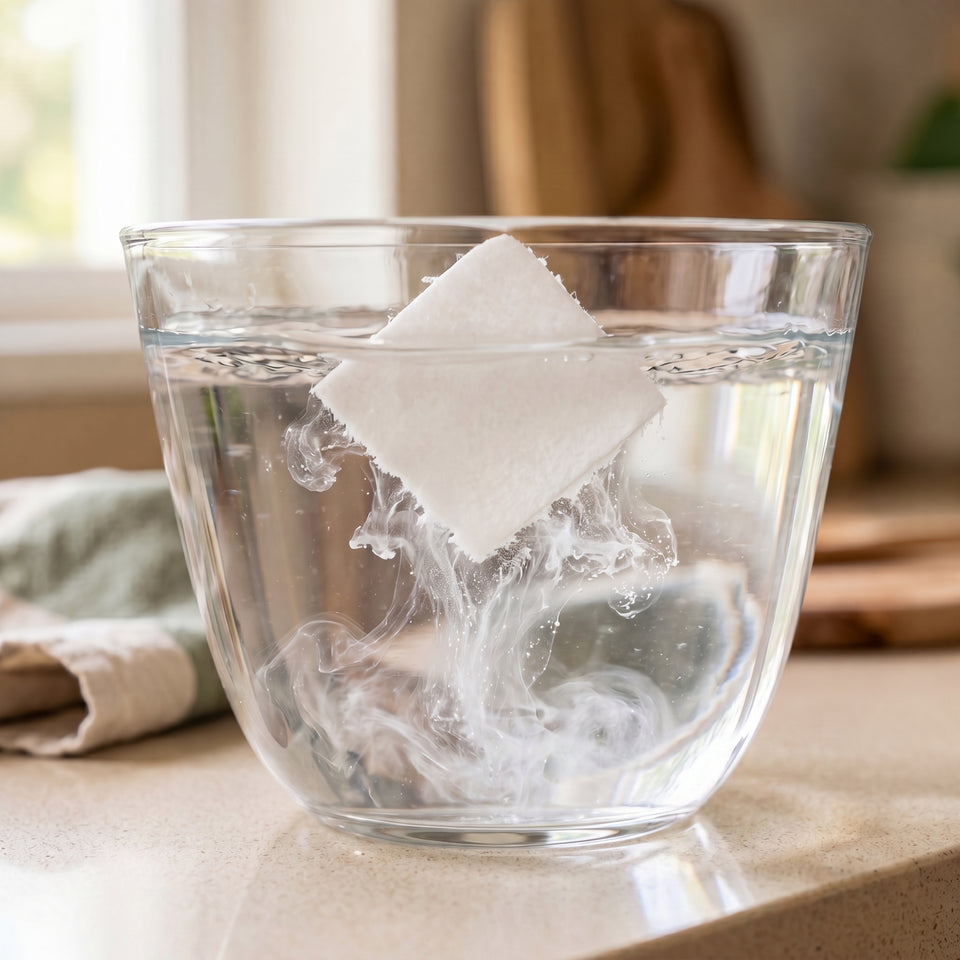
5.What changes for you when you switch over
What exactly changes when you switch?
Your glasses come out sparkling clean, without that fine film. The slight detergent taste, mentioned above, is gone.
And you're left with that calmer feeling, knowing what's left on your dishes and what isn't. For many, that's precisely the point.
One more thing for context. Tovara dishwasher sheets are new, so there aren't long lists of reviews here. This explains how the product works, not how many stars others have given it.
Isn't that expensive? How many washes does one pack last for?
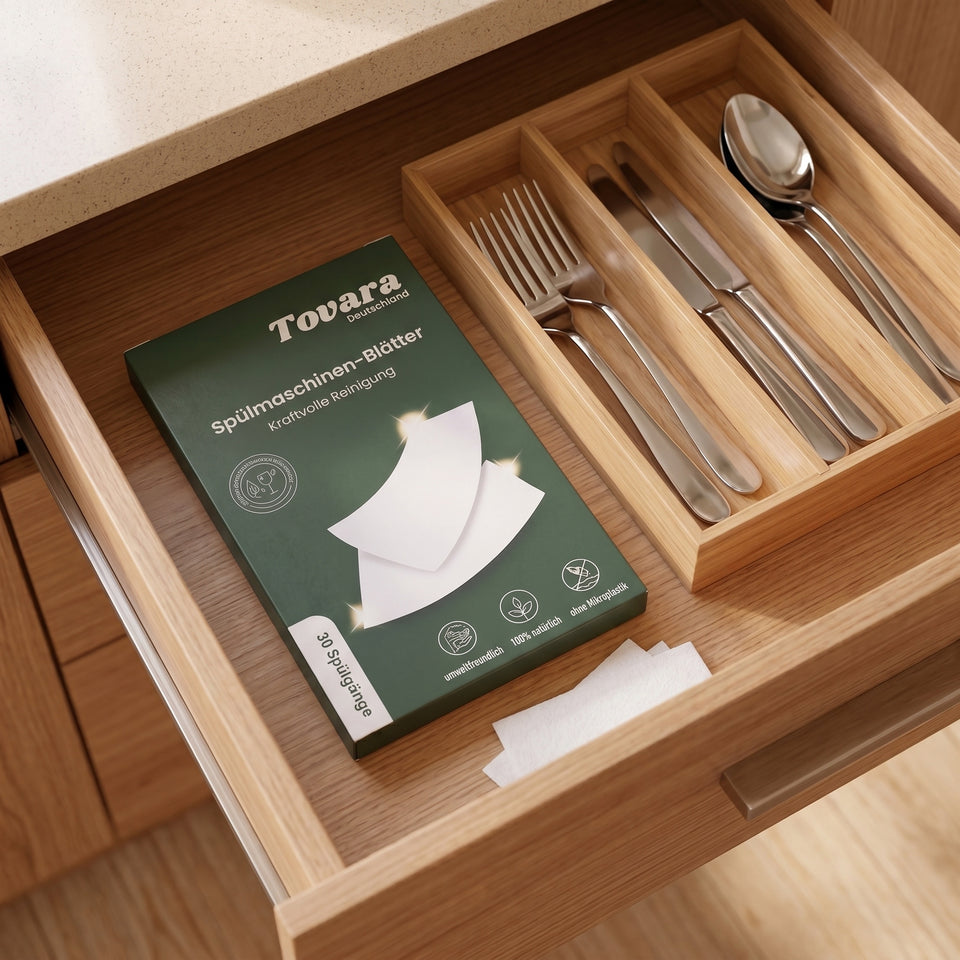
30 sheets. One whole sheet is enough for a full load, so 30 full washes. The sheets are divisible. Half a sheet for a light load, then you get up to 60 washes.
Löst sich das Tovara-Blatt nicht genauso auf?
Doch, es ist wasserlöslich, sonst würde es in der Maschine nicht funktionieren. Der Unterschied kommt danach: Mikroorganismen bauen das Blatt vollständig ab. Es verschwindet nicht nur aus dem Blickfeld, es verschwindet wirklich.
6.Why you can believe this
There's an easy way to find out what dish soap and rinse aid really do to your dishes: ask the person who repairs the machines.
A service technician sees every day what accumulates in machines and what rinse aid leaves behind over time. This is knowledge that no advertisement will tell you.
And if you're wondering which sources you can generally trust: Stiftung Warentest has been testing this category for years and is a good anchor for classifying detergents in general. The Tovara dishwasher sheets don't have their own rating there; the product is too new for that. This is mentioned here so you don't rely on a rating that doesn't exist.
What remains are the study, the package information, and the perspective of someone who knows the machines from the inside. From this, you can form your own opinion.
Where does the claim that no alkyl ethoxylates are present come from?
According to the manufacturer's data sheet, Tovara dishwasher sheets do not contain these substances. This is the documented status.
Woran erkennt man, dass ein halbes Blatt reicht?
Kleine Ladung, halbes Blatt. Volle Maschine, ganzes Blatt. Einfacher wird Dosieren nicht.
7.What all this boils down to
When you take everything into account, the question is simple in the end.
You want clean dishes. And you don't want substances left by other cleaners to end up back on your plate during your next meal.
This is precisely where Tovara dishwasher sheets come in. Powerfully clean thanks to the enzyme, without microplastics, without alkyl ethoxylates, without rinse aid.
Many people are gradually tackling things that never really belonged in the kitchen. Dishwashing is a good start because it happens every day.
Nothing more is needed at this point. You now have what you need to decide.
Was Kundinnen und Kunden sagen
Ich war ehrlich gesagt skeptisch. Aber der Unterschied beim Trinken ist da. Dieses leicht Seifige im ersten Schluck ist weg, und seitdem will ich nichts anderes mehr.
Gläser klar, kein Klarspüler mehr im Haus. Mehr wollte ich gar nicht.
Wir hatten vorher andere Blätter, da kam die Auflaufform genauso dreckig raus, wie sie reinging. Hier nicht. Sogar angetrocknetes Ei ist weg.
Bei unserem sehr harten Wasser gab es anfangs leichte Streifen. Salzfach aufgefüllt, seitdem alles top. Ein Stern Abzug, weil ich erst dachte, es liegt am Blatt.
Die Packung passt in die Besteckschublade. Ein Blatt rein, fertig. Bei halber Maschine reiße ich es einfach durch.
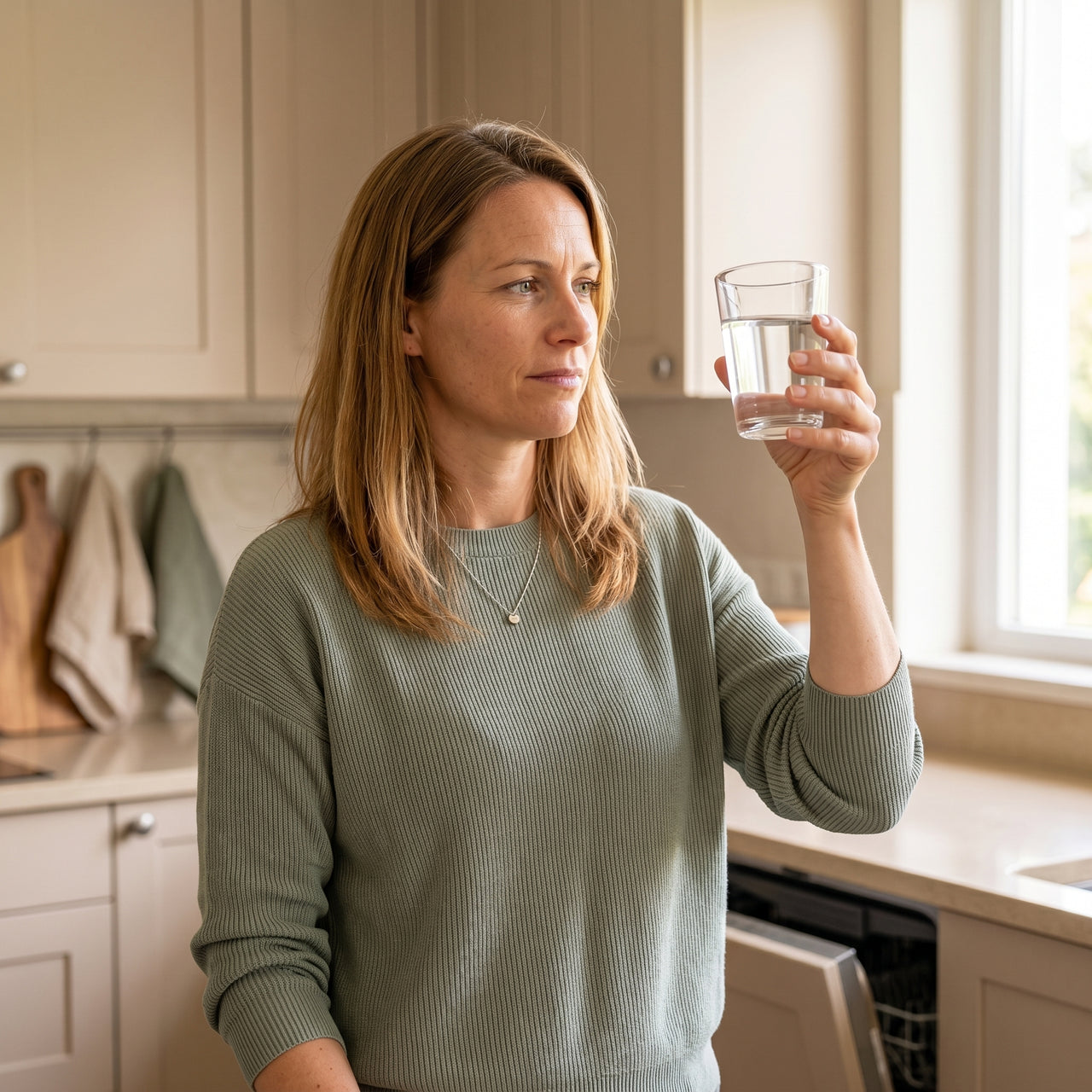
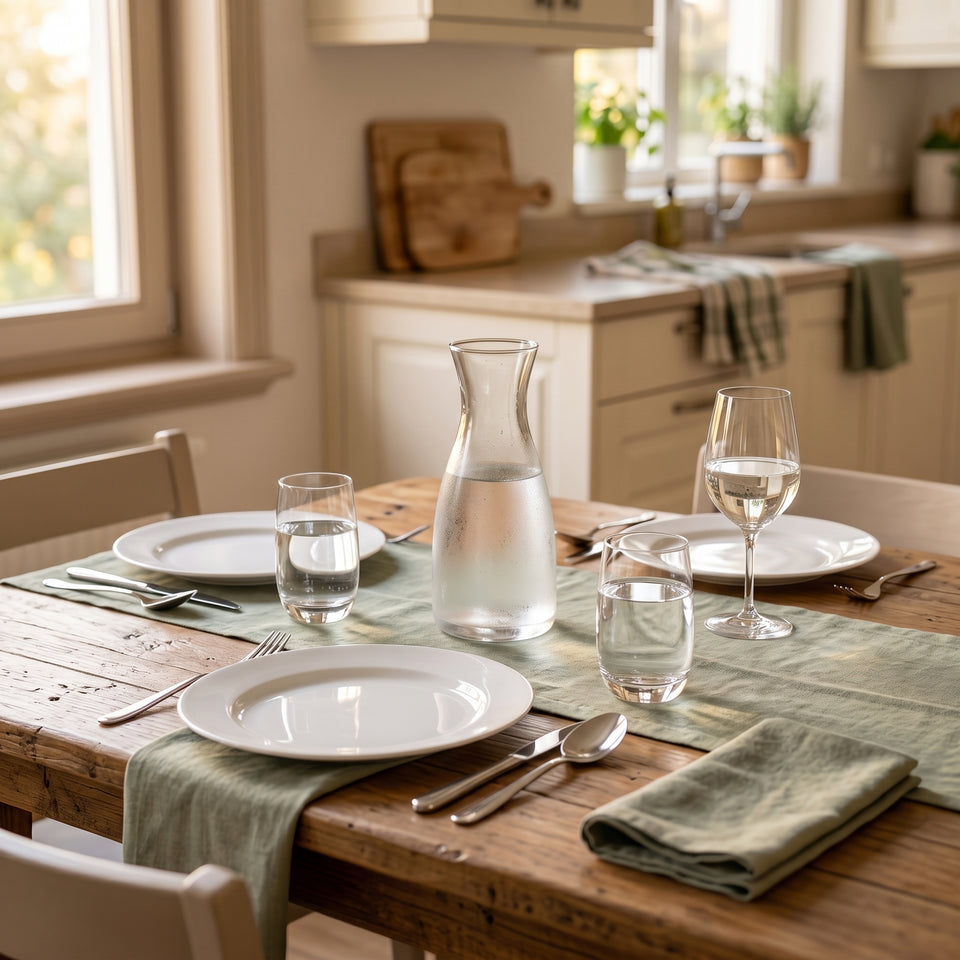
Imagine the next morning. You open the dishwasher, take out a glass, and it's just clear. No film, no strange taste with the first sip. And you know there's nothing on the plate that shouldn't be there.
What ends up on your family's plate is up to you.
Secure Payment · 100-Day Money-Back Guarantee · In stock – ships within 24 hours
Any further questions?
How are the leaves used?
In three simple steps:
1. Load the machine. Load as usual, even with heavily soiled items.
2. Insert the sheet. Place one sheet in the cutlery basket or on the bottom of the machine.
3. Start and done. The sheet dissolves completely. No residue, no film on the dishes.
Is additional salt needed?
Salt, as always, depends on the hardness of your water and your machine; that remains unchanged. You don't need a rinse aid.
How fast is shipping?
Your order ships within 1-2 business days. Most US orders arrive within 5 to 8 business days after they ship. Shipping is free on all US orders over $80.